Your Service Is a System: How Small Actions Create Shared Momentum
Your Service Is a System: How Small Actions Create Shared Momentum
By Michelle Walsh, Founder of Hourglass Time Education
I was learning about systems theory by Ludwig von Bertalanffy recently and, as often happens when I’m learning something new, it brought me straight back to leadership in early childhood.
It made me think about the way our services work. The relationships between people. The routines we establish. The expectations we communicate. And how a change in one room can affect what happens across the whole service.
Systems thinking asks us to look at those connections, rather than considering each part on its own. It recognises that what happens within a system is shaped by how its parts interact.
For me, that offers a useful question:
Are we leading a collection of individual rooms, or a connected service moving towards a shared vision?
The whole is greater than the sum of its parts
A service can have wonderful educators, capable room leaders and a passionate Director. But bringing talented people together doesn’t automatically mean they are working together.
The opportunity lies in connecting their efforts.
When everyone understands the vision, the goals and the improvement strategies, their everyday actions can start to support one another. A conversation in one room can spark an idea in another. A strategy trialled by one educator can help a colleague. Progress becomes something the team creates together.
This is one of the ideas we explore through distributed leadership in our Room to Lead™ program.
One practical strategy is to invite every team member to identify one achievable action each week that contributes to a shared improvement goal.
If you have 34 people in your team, that could mean 34 small actions moving your service forward.
The key is making the connection clear. Those actions need to contribute to the priorities in your Quality Improvement Plan, with the time and support people need to follow through.
For example, if your focus is strengthening children’s agency, one educator might review how children access resources. Another might explore children’s input into the daily routine. A room leader might support the team to reflect on when adults make decisions children could make themselves.
Different actions. A shared direction.
And potentially 34 opportunities to recognise effort, discuss learning and celebrate progress.
Shared momentum grows when people can see how their contribution matters.
When one part changes, the team needs attention
Systems theory also highlights interdependence: a change in one part can influence other parts of the system.
Think about what happens when someone new joins a room.
The routines might remain the same, but the relationships, communication and shared understanding have changed. Someone is now entering a team with its own expectations, habits and ways of working.
In Room to Lead™, we explore Tuckman’s team development model: forming, storming, norming and performing, with adjourning added later to recognise a team’s ending or separation.
I see this as a useful lens for leadership, rather than a fixed sequence every team must follow.
When membership changes, we may need to revisit the work of forming: welcoming people, clarifying roles and explaining how the team operates.
That includes casual educators and people moving between rooms.
One strategy we encourage is a room-specific induction, alongside the service’s broader induction.
It can help someone understand:
How the room’s routines work and why.
How educators communicate and share responsibilities.
What they need to know about the children.
Which improvement goals the team is working towards.
Where to ask questions or seek support.
What feels obvious to an established team may be completely unfamiliar to someone entering it.
Taking time to build that understanding helps people participate with greater confidence.
Open the doors between your rooms
The distinction between open and closed systems also caught my attention. Open systems exchange information and resources with their environment.
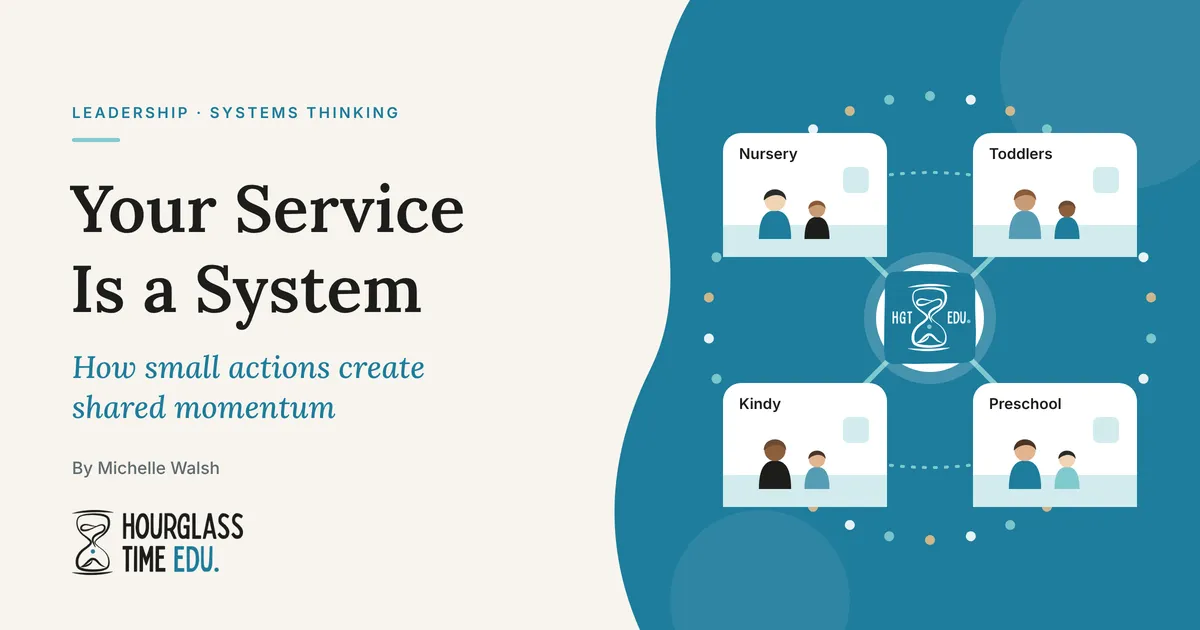
It reminded me of services where rooms have become quite separate in their thinking and practice.
Each room has its own resources, ideas and routines. Educators might be doing valuable work, but there are limited opportunities for that learning to travel.
I think of this as rooms working in silos, rather than literally being closed systems.
Through our HGT Quality Partnerships™, an early leadership focus is helping room leaders build connections across the service.
That might mean sharing a successful strategy, planning together, exchanging resources or discussing how a common improvement goal looks across different age groups.
A connected service still makes space for each room’s identity and the needs of its children. It also creates opportunities for everyone to contribute to the wider team.
What is working in one room that could help another?
Sometimes that question is enough to open a valuable conversation.
Feedback needs to lead somewhere
Feedback loops help systems respond and adapt. Information about what is happening feeds back into what happens next.
In an early childhood service, we can apply that idea through everyday observation, reflection and collaboration.
We notice something. We discuss it. We adjust our approach. Then we check what changed.
Perhaps the team trials a different transition routine. Educators observe how children respond, share their experiences and make further adjustments.
The loop remains open until we return to the question: Did this help, and what do we need to do next?
Leaders play an important role in making those conversations useful. People need to feel able to raise concerns, share ideas and acknowledge when something hasn’t worked.
Children’s responses and families’ perspectives matter too. They help us understand the experience our systems are creating.
What could this mean for your service?
Thinking about your service as a system invites you to look beyond individual tasks and consider the connections that make progress possible.
Start with these questions:
Can every team member explain the improvement goal they are contributing to?
How do we help people settle into a room team?
Where are ideas and resources flowing between rooms?
What happens after someone offers feedback?
How do we recognise small actions and check their impact?
Choose one question to explore with your leaders this week.
At Hourglass Time Education, this is central to the leadership work we do: helping teams build shared understanding, practical ways of working and the confidence to contribute.
When people understand their role, connect their efforts and learn together, quality improvement becomes part of the everyday life of the service.
What is one small action your team could take this week? How will you help those actions connect?
If you’d like support to strengthen leadership and shared improvement across your service, book a discovery call with Hourglass Time Education to explore our HGT Quality Partnerships™ or Room to Lead™ program.
